Choosing acoustic wall panels in China is not just a price comparison. Buyers need to assess measured acoustic performance, material consistency, finish quality, and export readiness. A sample may look excellent under showroom lights, yet behave differently across a large order. Small details count.
Wallace Clement Sabine, a pioneer of architectural acoustics, defined reverberation time as “the time required for sound to decrease to one-millionth of its original intensity.” That principle still matters: panels should suit the room, not merely decorate it. Ask suppliers for test reports that identify the tested product, mounting method, and frequency range. Compare these details carefully. A single rating rarely tells the whole story.
For global projects, confirm panel dimensions, core materials, fabric options, edge treatment, packaging, and lead times in writing. Check whether the documentation matches the actual specification. Requirements can differ by destination, so buyers should verify applicable project and market standards before ordering. Looks matter, too.
This guide examines Chinese manufacturers, product types, performance claims, and questions worth asking before purchase. It also recognizes a practical limitation: supplier information can be incomplete, and no shortlist replaces independent verification. Even a well-written specification can miss a production detail. The aim is not to declare one supplier universally “best,” but to help buyers make a better-informed comparison and reduce avoidable surprises.

China Best Acoustic Wall Panels for Global Buyers?
How Acoustic Wall Panels Work: NRC Testing Under ASTM C423
For buyers comparing acoustic wall panels, NRC offers a useful starting point, not a complete verdict. Under ASTM C423, a laboratory measures sound absorption in a reverberation room. Technicians record how quickly sound decays with and without the test specimen. The difference helps determine the specimen’s absorption performance. The room is large, reflective, and carefully controlled. That matters.
NRC, or Noise Reduction Coefficient, is a rounded average of absorption values at 250, 500, 1,000, and 2,000 Hz. A panel with an NRC of 0.80 shows strong average absorption across those tested frequencies, but the figure is not a guarantee for every room. It does not show how much sound passes through a wall. Nor does it describe every frequency. Not quite.
Check the full ASTM C423 report, including specimen size, mounting method, air gap, and frequency data. A panel installed directly on drywall may perform differently from one mounted with a cavity behind it. Room shape, furnishings, ceiling height, and panel coverage also affect results. For a meeting room with sharp echoes, compare test conditions with the planned installation and seek project-specific guidance. Lab ratings simplify real rooms, so use NRC as evidence and verify the details before specifying panels.
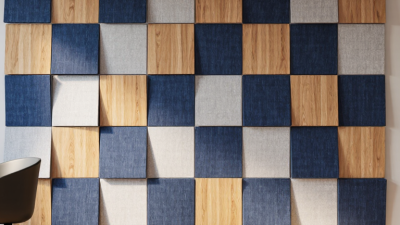
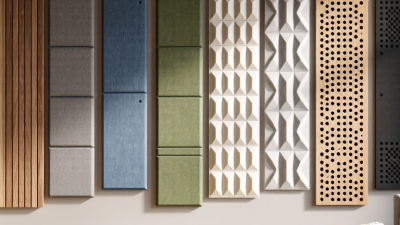
China supplies several acoustic wall-panel types, but the material alone does not determine performance. PET felt panels are lightweight and easy to cut around outlets or corners. Their color and thickness vary, so compare physical samples under the room’s actual lighting. Some panels use recycled fibers; ask for clear material and fire-test documentation rather than relying on a short product description. Small details matter.
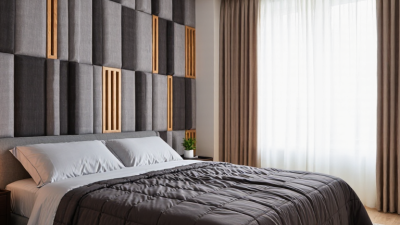
Fabric-wrapped panels usually combine an absorbent core with a replaceable-looking fabric finish, though not every cover is easy to remove. Check the fabric weave, edge construction, and backing before ordering. Wood-slat panels add a warmer, linear appearance. Slat width, spacing, and the acoustic layer behind them affect both the look and the sound absorption. A wood face can be attractive without being solid wood. Confirm the stated construction.
Foam panels are light and useful for reducing room reflections, especially in studios or meeting spaces. They generally do not stop sound passing through walls. One easy mistake: treating absorption as soundproofing. Request test results for the complete panel assembly, including its core and mounting method. Also confirm panel dimensions, color consistency, packaging, and replacement availability. I would not treat a polished sample as proof of a dependable shipment; sometimes the sample is better finished than the production batch. Ask how batches are checked, and keep expectations realistic.
Typical product specifications can vary widely with thickness, backing, air gap, and installation. These indicative ranges are for comparison, not guaranteed category ratings; check tested data for each product.
NRC (Noise Reduction Coefficient) is a single-number rating of sound absorption, generally on a scale from 0 to 1. Actual performance depends on the specific panel and test conditions.
When comparing acoustic wall panels, look beyond color, thickness, and price. ISO 11654 assigns a weighted sound absorption value, αw, and Class A requires αw of at least 0.90. That matters. A high rating can help buyers compare products, but only when test conditions are comparable.
Read the laboratory report carefully. Check the panel’s mounting method, air gap, and tested size; these details can change measured absorption. Review the frequency-band results too, especially if a room has booming speech or bass. A single number can feel reassuring, yet it may hide weaker performance at lower frequencies. It is easy to overlook that distinction when comparing quotes. Ask for the full report, not just a sales-sheet rating, and confirm that the tested assembly matches your planned installation.
Tips: Check the setup. Compare reports using similar mounting conditions, then match the result to your room’s needs. If possible, request a sample and inspect its edges, finish, and mounting hardware before ordering. A Class A rating is useful evidence, not a promise that every room will sound perfect.
China Best Acoustic Wall Panels for Global Buyers?
When comparing acoustic wall panels, check the exact product’s EN 13501-1 classification, not a general statement about the material. This European system classifies reaction to fire, from A1 to F, with additional smoke and flaming-droplet ratings for relevant classes. A result applies only to the tested construction. Panel thickness, surface finish, adhesive, backing, and mounting method can affect performance. Ask for the full report and confirm its sample matches the panels you plan to buy.
Tips: Check the report number, laboratory, test date, and classification details. Compare the stated installation method with your project. If panels will be bonded to a wall, a test using a different fixing method may not represent your setup. Small details matter.
Request a VOC emissions report as well. It should identify the tested product and show the test method, chamber conditions, sampling period, and measured results. Look for clear values, not just “low VOC” wording. Requirements differ between projects and markets, so confirm the criteria with your project team. Reports can be easy to misread; I would double-check units and product names before approval. A careful paper check is less exciting than choosing a finish, but it can prevent costly surprises.
| Check Item | What the Data Means | What Buyers Should Verify | Evidence to Request |
|---|---|---|---|
| Fire classification standard | EN 13501-1 classifies a construction product’s reaction to fire based on applicable test results. | Confirm the report names EN 13501-1 and identifies the exact panel construction and intended use. | Full classification report, including report number, issue date, laboratory, and tested product description. |
| Main fire class | Classes run from A1 and A2, through B, C, D and E, to F. A1 represents the highest reaction-to-fire class; F indicates no determined performance or failure to meet class E criteria. | Check the class required by local building regulations and the project specification. A better class should not be assumed without a valid report. | Classification shown exactly as reported, with the applicable test basis and product scope. |
| Smoke production | For applicable classes, the supplementary smoke rating is s1, s2 or s3; s1 indicates the lowest smoke production category and s3 the highest category. | Check whether the classification includes a smoke suffix, such as B-s1, and whether that rating is required for the installation. | The complete classification designation, not just the main letter class. |
| Flaming droplets or particles | For applicable classes, d0, d1 and d2 describe flaming droplets or particles, with d0 indicating no flaming droplets or particles within the test criteria. | Check whether a d-rating is reported and whether the project code or specification requires one. | Full rating, for example “B-s1,d0,” where applicable; do not infer missing suffixes. |
| Tested assembly and mounting | Fire performance can depend on the product build-up and mounting conditions represented in the test or classification scope. | Match panel thickness, facing, core, adhesive, air gap, substrate and fixing method to the reported configuration. | Report scope or field of application stating permitted variations and installation conditions. |
| VOC test method | Common chamber-based approaches include EN 16516, the ISO 16000 series and ASTM D5116. These methods are not interchangeable by name alone. | Check the exact method, chamber conditions, sampling details and whether the method matches the destination market’s requirements. | Complete laboratory report identifying the method, test conditions, sample preparation and analytical results. |
| VOC results and limits | Reported emissions may include total VOCs and individual compounds. Acceptance limits depend on the applicable regulation, certification scheme or project specification. | Compare measured results with the relevant market or project criteria; do not treat “low VOC” as a universal pass/fail category. | Results with units, sampling or chamber time points, detection limits where available, and the criteria used for any pass statement. |
| Sample identity and traceability | A report applies to the sample and product configuration it identifies; similar appearance alone does not establish equivalence. | Match the report’s product description, composition, thickness and production details to the goods being purchased. | Sample identification, photographs or description, product specification, and confirmation that supplied goods match the tested construction. |
| Laboratory and report integrity | Accreditation and report traceability help buyers assess how testing was conducted; the relevant scope should cover the test method. | Verify the issuing laboratory, report authenticity, test date and accreditation scope where applicable. | Signed or verifiable report and, where relevant, current laboratory accreditation scope. |
Note: Fire classifications and VOC results are product- and test-configuration-specific. Confirm applicable requirements with the project team or relevant authority before specifying or installing acoustic wall panels.
When comparing acoustic wall panels, request the full ISO 354 test report, not just a headline absorption figure. Check the specimen dimensions, frequency bands, mounting method, and whether an air cavity was used. The results apply to that tested assembly, not automatically to every wall. Small details matter. A report helps, but it cannot replace a room-specific acoustic review.
Specify panel thickness and construction in writing. A 25 mm panel may perform differently from a 50 mm panel, particularly at lower frequencies. Ask whether the stated thickness includes the fabric, backing, or frame. For speech-focused spaces, compare frequency-band data rather than relying on one averaged number. Ask for the report. It is a simple request, yet it is sometimes missed.
Include the wall substrate, fixing method, and intended cavity depth in the mounting specification. Request installation drawings or test evidence that matches the proposed assembly; changing the panel spacing may affect absorption. Confirm MOQ by color, thickness, and panel size, and clarify packaging and lead-time assumptions. Mixed-color limits can make a flexible order less flexible. I would check that detail twice.