Choosing the best acoustic wall panels supplier in China takes more than comparing prices or browsing polished product photos. Buyers need to understand what each panel is designed to do, how it is made, and whether its documented performance suits the room. Acoustic treatment can reduce reflections and improve listening comfort, but it does not automatically block sound from passing between rooms. That distinction matters.
A useful supplier review starts with practical details: panel core, fabric or veneer finish, dimensions, mounting method, and available test reports. Ask how absorption data was measured and whether the report covers the exact product being quoted. Check sample quality in natural light; a fabric that looks even online may show seams or color shifts up close. Small details count.
Compare communication, customization options, production timelines, packaging, and after-sales support alongside price. Request clear drawings and written specifications before approving a large order. A reliable supplier should answer technical questions directly, explain limitations, and avoid promising identical results in every space. Even good panels can disappoint when placement, room shape, or installation is overlooked. There is no perfect shortcut.
This guide examines the factors that help buyers assess Chinese manufacturers with care, from product evidence to project coordination. Some information may still require direct confirmation, especially when specifications change between models. A thoughtful comparison is worth the extra time.
Best Acoustic Wall Panels Supplier in China?
What Acoustic Wall Panels Are and How They Work
Acoustic wall panels absorb sound reflections inside a room. They do not fully soundproof a space or block noise traveling through walls. Many panels use porous materials, such as mineral wool or polyester fiber, behind a fabric covering. Sound enters the material, where friction converts some acoustic energy into small amounts of heat. The result can be less echo and clearer speech. A useful distinction.
Performance is often tested under ASTM C423, which measures sound absorption in a reverberation room. The Noise Reduction Coefficient, or NRC, summarizes absorption at four frequencies: 250, 500, 1,000, and 2,000 Hz. It is a helpful comparison, not a promise of identical results in every room. Panel thickness, air gaps, placement, and room finishes all matter. Installation details can disappoint.
Room targets also depend on how the space is used. ANSI/ASA S12.60-2010/Part 1 sets a maximum reverberation time of 0.6 seconds for certain unoccupied classrooms up to 10,000 cubic feet. That figure is not a universal target for offices, restaurants, or homes. When comparing suppliers, request test reports that identify the product and mounting method. Check the frequency data, too; a single NRC value can hide weaker low-frequency absorption. A supplier’s specification is only as useful as its test conditions.
Porous acoustic panels absorb some sound energy as air moves through their fibers, helping reduce reflections and reverberation. The chart shows the idealized quarter-wavelength depth for each frequency, calculated using a sound speed of 343 m/s. It illustrates why low-frequency sound generally requires greater absorber depth; actual panel performance depends on material, thickness, air gap, mounting, and tested absorption data.
A reliable supplier should provide independent acoustic test reports, not just a headline NRC value. Ask whether testing followed ASTM C423 or ISO 354, and check results across frequencies. A panel may absorb mid-range speech well but perform poorly at lower frequencies. Compare samples at the same thickness, finish, and mounting method. Small details matter. Request production-batch checks, too; one attractive sample cannot prove consistent output.
The WHO’s 2018 Environmental Noise Guidelines recommend keeping road-traffic noise below 53 dB Lden and 45 dB Lnight. These are health-based outdoor exposure recommendations, not panel ratings.
Still, they help clarify a key point: absorption panels reduce room reverberation, but do not automatically block outside noise. Ask suppliers to explain this difference plainly. Also review fire-test documentation, material composition, packaging, lead times, and how damaged panels are handled.
Verify that the test report names the exact product construction you plan to order. I would not treat a low price as proof of value; freight, replacement stock, and uneven colour batches can change the real cost.
And honestly, supplier paperwork can look convincing while leaving gaps. Ask direct questions, then verify the answers.
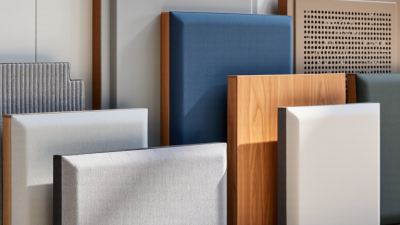
Choosing acoustic wall panels from a China-based supplier starts with the room, not the catalogue. PET felt panels are lightweight and available in many colors. They can soften speech reflections in offices or meeting rooms. Fabric-wrapped mineral-fiber panels often absorb more sound, especially when thicker. They suit spaces where speech clarity matters more than a hard-wearing surface. Wood-slat panels add warmth, but the slats alone do not guarantee strong absorption. Their backing and cavity depth matter.
Design changes performance. A 25-millimeter panel mounted directly on a wall may behave differently from the same panel installed with an air gap. Ask for the build-up. Request test data for the exact panel thickness, backing, and mounting method, not a rating copied from another product. Compare absorption by frequency, since low voices and sharp echoes do not respond equally. A single overall rating can be useful, but it is not a verdict.
Looks matter too. Check fabric samples under the room’s actual lighting, and inspect the edges and fixing details. In supplier discussions, clarify panel dimensions, color consistency, packaging, and replacement lead times. These details can affect installation as much as the acoustic specification. There is no perfect panel for every room. Even careful comparisons leave some uncertainty until the panels are installed and the space is tested.
| Panel Type / Core Material | Typical Design | Indicative NRC Range* | Acoustic Characteristics | Advantages | Points to Check | Common Applications |
|---|---|---|---|---|---|---|
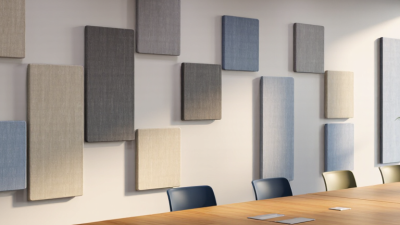
| Fabric-wrapped mineral wool or fiberglass | Porous core inside a fabric-covered frame; commonly supplied in flat wall panels. | About 0.70–1.00 for tested products, depending on thickness, density, air gap, and mounting. | Broadband sound absorption; thicker panels or an air gap can improve lower-frequency absorption. | Often a strong choice for reducing room reverberation; many fabric and size options. | Request test reports for the exact panel build-up. Check fabric durability, edge finish, fire performance, and installation details. | Offices, classrooms, meeting rooms, studios, and auditoriums. |
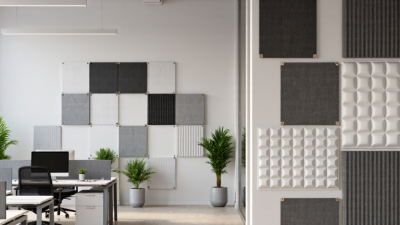
| Recycled PET felt | Self-supporting felt sheets or shaped and layered panels; may be cut into decorative patterns. | Approximately 0.30–0.80 across product designs; thickness and mounting make a substantial difference. | Primarily absorbs mid- and high-frequency sound; performance at lower frequencies is limited unless the system is thicker or spaced off the wall. | Lightweight, easy to fabricate into shapes, and available in a range of colors and surface patterns. | Confirm recycled-content claims, panel thickness, fire-test documentation, and measured absorption for the proposed mounting method. | Workspaces, schools, reception areas, and decorative interior walls. |
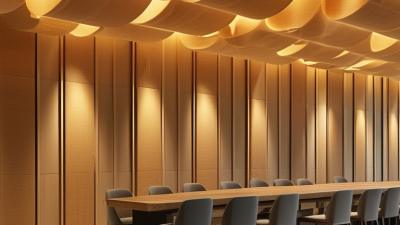
| Wood slat panels with an acoustic backing | Timber or wood-veneer slats mounted over a sound-absorbing felt or porous layer. | Often around 0.50–0.90 for complete tested assemblies; spacing, backing, and any cavity affect results. | The slat-and-backing assembly absorbs sound; the decorative slats alone should not be assumed to provide equivalent absorption. | Combines a linear wood finish with acoustic backing and can cover large wall areas. | Check the tested assembly, slat and gap dimensions, backing material, veneer or finish specification, and fire classification. | Conference rooms, hospitality spaces, offices, and residential interiors. |
| Perforated wood or MDF with an acoustic cavity | Perforated or slotted facing with sound-absorbing material and a defined cavity behind it. | Can range roughly from 0.40–0.90, depending on perforation pattern, backing, cavity depth, and test method. | Perforations allow sound to reach the backing; tuned designs may target particular frequency ranges. | Offers a hard, cleanable decorative face with an acoustic layer behind it. | Request results for the exact perforation, backing, and cavity configuration. Check panel joints and installation tolerances. | Auditoriums, corridors, public buildings, and interiors requiring a wood-look finish. |
| Open-cell acoustic foam | Lightweight foam in flat, wedge, or profiled shapes, usually bonded directly to a surface. | Varies widely; approximately 0.30–0.90 is possible across different thicknesses and test conditions. | Typically more effective at mid and high frequencies; thin foam is generally less effective at low frequencies. | Lightweight and easy to cut and install on suitable surfaces. | Verify fire performance, smoke requirements, odor and emissions information, and the test data for the selected thickness. | Small recording rooms, voice booths, and selected equipment or practice spaces. |
*Important: NRC (Noise Reduction Coefficient) is a rounded, single-number measure of sound absorption, not sound isolation. The ranges above are indicative rather than guaranteed product specifications. Results depend on the complete panel assembly, thickness, mounting, test standard, and laboratory report. For supplier comparisons, request current test documentation for the exact product and installation configuration.
When comparing acoustic wall panel suppliers in China, ask for test evidence tied to the exact panel construction. The European Environment Agency’s 2020 Environmental Noise in Europe report estimated that about one in five Europeans experiences harmful long-term transport noise. That figure concerns outdoor exposure, not indoor panel performance, but it shows why acoustic claims deserve careful checking. Ask for laboratory reports showing sound absorption results, such as tests under ISO 354 or ASTM C423. Check that the tested thickness, core, and finish match your order.
Certificates need context. ISO 9001 describes a supplier’s quality-management system; it does not certify every panel’s acoustic performance. Request current certificates, production-lot records, and test reports from an identified laboratory. For fire performance, verify the applicable test method and the classification stated in the report. Small details matter. A fabric change can affect results.
Customization should be practical, not just visual. Confirm dimensions, edge treatment, mounting method, fabric options, and minimum order quantities before sampling. A reliable supplier can provide a sample panel and document its materials, weight, and installation details. Ask how color variation and replacement panels are handled across batches. I would still inspect a production sample: paperwork can look complete while a real installation reveals uneven edges or difficult mounting.
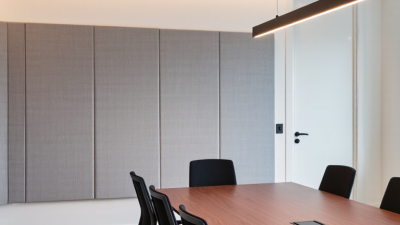
A suitable acoustic wall panel supplier should match the room, not just the product photo. List the project’s main needs: speech clarity, reduced echo, appearance, budget, and installation method. For a meeting room, ask for test data on sound absorption, including the tested panel thickness and mounting setup. A single rating cannot describe every room.
When sourcing from China, request physical samples and compare fabric, edge finish, backing, and color in the actual lighting. Ask for production lead times, minimum order quantities, packaging details, and replacement procedures. Check whether the supplier can provide drawings and installation guidance for your wall type. Small details matter. A panel that looks right may still clash with sprinklers, outlets, or wall trims.
Confirm that reports apply to the exact material and construction you plan to buy. If fire performance or recycled content matters, request supporting documents and check them against your project specifications. Discuss how samples become approved production pieces, and agree on acceptable color and finish variation. I have seen projects lose time over details that seemed minor on a sample. No supplier can remove every risk, so keep written records and allow time for a pre-production check.