China has become a major source of acoustic products, but choosing sound blocking panels requires more than comparing prices. A polished surface does not automatically stop noise. Wall structure, panel mass, airtight installation, and sound frequency all affect real performance. Low voices, machinery vibration, and sharp outdoor traffic noise require different solutions.
Dr. Lily M. Wang, a respected acoustical engineering professor, states, “A good acoustic design starts with understanding the source, the path, and the receiver.” This principle matters when evaluating Chinese manufacturers. A credible supplier should provide laboratory data, installation guidance, material specifications, and traceable quality records. Look for tested sound transmission ratings, such as STC, while remembering that laboratory results may differ from field performance. Small gaps around edges can reduce effectiveness dramatically.
Details matter.
This guide compares sound blocking panels for offices, studios, factories, hotels, and residential rooms. It examines panel density, core materials, surface durability, fire performance, acoustic seals, and mounting systems. It also considers whether a product blocks noise or merely absorbs echoes. Those functions are not identical. A lightweight foam panel may soften room reverberation but fail against a neighboring compressor.
Some recommendations will remain practical rather than absolute. The “best” panel depends on the building, budget, frequency range, and installation quality. Even expert judgments can change after an on-site inspection. Buyers should request current test reports and samples before placing large orders. A hand-sized sample cannot reveal everything. However, it can expose weak edges, unpleasant odors, fragile coatings, and misleading product claims.
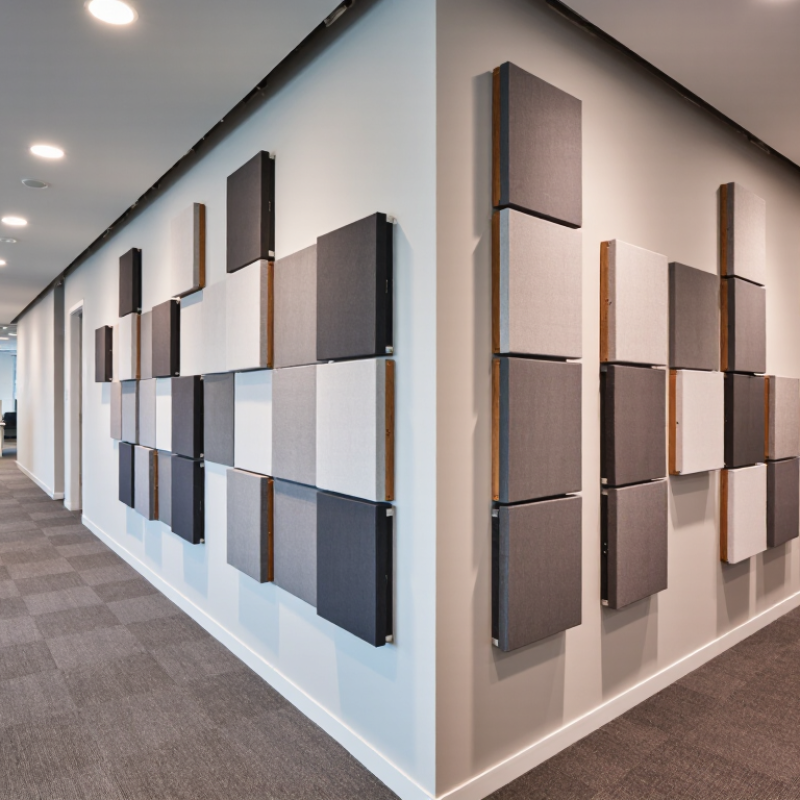
Sound blocking panels are designed to reduce sound passing through walls, ceilings, doors, or partitions. They work differently from ordinary acoustic panels. Absorbing panels reduce echoes inside a room, while blocking panels slow transmission between spaces. This difference matters.
Effective blocking usually depends on mass, airtightness, and separation. Dense materials resist vibration. Sealed joints prevent voices from escaping through small gaps. Decoupled layers reduce direct contact between surfaces.
Some commercial panels combine heavy cores with resilient layers and fabric finishes. Others use mineral-based or composite materials. Performance depends on the complete wall system, not the panel alone.
A practical installation starts with the weakest points.
Check door edges, electrical outlets, ceiling joints, and pipe openings. A visible gap beside a door can undermine an expensive treatment. Panels should fit tightly and remain properly supported. Always review tested ratings, installation details, and fire-safety documentation. Laboratory results may not match a busy apartment, office, or factory. That distinction is easy to miss.
No panel is magic. Many products marketed as “soundproof” mainly absorb reflections. They can make speech clearer without stopping loud voices next door.
In China, buyers should compare material density, thickness, test standards, moisture resistance, and after-sales technical support. A small sample test is wise before covering an entire room.
Sometimes the best solution is less attractive. A sealed, layered wall often outperforms decorative panels placed loosely.
Chinese manufacturers produce several practical types of sound blocking panels. Mass-loaded vinyl is flexible, dense, and often installed behind drywall or ceilings. Damping composite sheets combine polymers with metal or gypsum layers. They reduce vibration from machinery, voices, and traffic. Acoustic barrier curtains offer movable separation for studios, factories, and temporary work areas. Perforated metal and mineral wool panels are also common, but they mainly absorb sound. They do not block transmission alone.
MarketsandMarkets estimates the global soundproofing materials market could reach about US$19.5 billion by 2028. This growth supports wider Chinese production of laminated barriers, acoustic sandwich panels, and modular partitions. However, “thicker” does not always mean “better.” Performance depends on mass, airtight joints, decoupling, and installation quality. ISO 10140 and ASTM E90 provide recognized laboratory methods for testing airborne sound insulation. Ask suppliers for reports using comparable standards. A missing test frequency range deserves caution.
Tips: Match the panel to the noise path. Use MLV for wall cavities, damping sheets for vibrating metal, and barrier curtains for flexible zones. Check density, thickness, fire classification, and edge sealing. Request samples before ordering. In my experience, installation mistakes often weaken an otherwise capable panel. That detail is easy to underestimate. Where reports rely only on single-number ratings, request frequency data, especially below 250 Hz. Low-frequency noise remains difficult.
Typical surface density of sound-blocking panel types manufactured in China
Surface density is a practical indicator of airborne sound-blocking potential: heavier panels generally provide stronger mass-based isolation when installed without gaps. Cement board and steel panels are commonly selected for high-demand partitions, while gypsum board, plywood, and mass-loaded vinyl are often combined in layered wall systems. Actual acoustic performance depends on thickness, joints, framing, decoupling, and installation quality; the values shown are representative ranges converted to typical midpoints, not laboratory STC or transmission-loss ratings.
When buyers compare Chinese sound blocking panels, they often confuse absorption with isolation. A soft panel may reduce echo, yet it cannot stop machinery noise passing through a wall. The useful question is simple: how much sound does the complete assembly block? Request laboratory transmission-loss data, not only a product brochure. Look for test frequency bands, mounting conditions, sample thickness, and the stated test standard. Numbers without test conditions deserve caution.
In practical factory checks, I compare the same panel size, then inspect mass, core structure, joints, and perimeter seals. A heavier barrier usually blocks lower frequencies better, but weight alone proves little. For a workshop beside an office, test around 125, 250, and 500 Hz, where engines and compressors often create trouble. Ask for STC or Rw ratings, while remembering that one rating can hide weak low-frequency performance. Small gaps matter.
Performance also depends on installation. Check whether Chinese suppliers provide drawings, overlap details, fastener spacing, and replacement guidance. Fire resistance, moisture tolerance, and formaldehyde emissions should match local building requirements. An independent inspection can verify thickness, surface damage, and packing quality before shipment. I would also request a sample installation, because laboratory results may not survive careless sealing. This is where comparisons become less tidy. Price is not performance; align costs with verified testing, compliance, support, and installation quality.
What Are the Best Sound Blocking Panels in China?
Choosing sound blocking panels requires more than checking thickness. In my installation experience, mass and airtight construction matter most. A dense gypsum or cement-based core can resist airborne noise better than lightweight foam. Mineral wool helps absorb energy inside a cavity, but it does not block sound alone.
Look for layered panels with a heavy barrier, resilient backing, and sealed edges. Mass-loaded vinyl can improve low-frequency control when installed without gaps. A 50-millimeter mineral wool layer may reduce reflections around a studio wall. It will not stop bass through an open joint. Small cracks near sockets, corners, and doors often weaken an otherwise expensive system.
I also check independent laboratory data, including transmission loss, frequency ranges, and installation conditions. Marketing claims can sound impressive. The test details matter more. In apartments, panels with interlocking edges and compression seals are practical. In factories, moisture resistance and fire performance deserve closer attention. I once focused too heavily on panel density and overlooked the supporting wall. That mistake taught me to inspect the full assembly, not one product. Sound absorption ratings can also mislead buyers, because absorption and blocking are different jobs.
| Panel or Barrier Type | Main Material | Primary Function | Typical Acoustic Contribution | Features That Matter Most | Best Application | Important Limitations |
|---|---|---|---|---|---|---|
| Mass-loaded vinyl barrier | Flexible high-density polymer filled with mineral materials | Adds mass to walls, ceilings, floors, and enclosures | Improves transmission loss when installed continuously and without gaps | High surface density, flexible installation, sealed joints, fire and odor documentation | Partition upgrades, equipment enclosures, studios, and mechanical rooms | Does not absorb room reverberation by itself; penetrations and flanking paths can reduce results |
| High-density gypsum composite panel | Gypsum board, mineral core, or laminated multi-layer board | Creates a heavier, stiffer partition surface | Supports higher wall-system sound transmission loss when combined with a suitable frame and cavity | Panel mass, thickness, multiple layers, staggered joints, and tested system ratings | Interior walls, office partitions, apartments, and commercial fit-outs | Performance depends on the complete wall assembly rather than the panel alone |
| Mineral wool infill panel | Stone wool or glass mineral fiber | Absorbs sound inside wall, ceiling, or enclosure cavities | Reduces cavity resonance and improves the sound insulation of a properly sealed partition | Appropriate thickness, stable density, full cavity coverage, non-settling structure, and fire classification | Stud walls, suspended ceilings, doors, machinery enclosures, and HVAC housings | It is mainly an absorber; it cannot replace mass, airtightness, or structural isolation |
| Acoustic sandwich panel | Metal or gypsum facings with mineral wool or another acoustic core | Combines enclosure strength, absorption, and partial transmission control | Can provide useful sound reduction when panel joints, doors, and penetrations are properly detailed | Core thickness, face mass, tongue-and-groove joints, airtight seals, and tested laboratory performance | Factories, generator rooms, workshops, plant rooms, and modular acoustic enclosures | Lightweight panels may block low-frequency noise less effectively than heavier composite systems |
| Mass-loaded acoustic curtain | Flexible vinyl or rubber barrier with fibrous absorbent layers | Provides a movable, overlapping sound-control screen | Offers moderate reduction when curtains are heavy, full-height, and installed with generous overlaps | Areal weight, floor-to-ceiling coverage, overlap, perimeter seals, grommet strength, and track design | Temporary partitions, workshops, stages, warehouses, and production areas | Gaps at the top, bottom, and sides can significantly reduce sound-blocking performance |
| Acoustic door or access panel | Layered steel, timber, or composite construction with seals | Controls the weakest opening in many sound-isolated rooms | Can preserve the rating of a wall when its tested performance matches the surrounding assembly | Solid core, compression seals, automatic drop seal, frame rigidity, and verified laboratory rating | Studios, conference rooms, plant rooms, cinemas, and recording spaces | A high-rated wall can underperform if the door, frame, or threshold is poorly sealed |
| Resilient isolation panel | Rubber, elastomer, cork-rubber, or resilient mineral-fiber composite | Reduces vibration transfer between structures | Helps control impact and structure-borne noise when correctly loaded and decoupled | Dynamic stiffness, load capacity, compression behavior, thickness, and continuous support | Floating floors, machinery bases, pipe supports, ceilings, and resilient wall systems | It is not a substitute for an airtight, massive barrier against airborne noise |
Choosing a sound blocking panel supplier in China requires more than comparing prices. The World Health Organization’s 2011 Burden of Disease report linked traffic noise with over one million lost healthy life-years annually in Western Europe. This highlights why acoustic performance needs measurable evidence, not attractive product claims.
Ask suppliers for laboratory reports based on ISO 10140-2 or ASTM E90. These standards help verify airborne sound insulation under controlled conditions. Check the tested frequency range, transmission loss, panel thickness, and installation method. A high rating at one frequency may hide weak low-frequency performance. Request samples and inspect their mass, edge sealing, surface finish, and internal structure. Small gaps can reduce real-world results.
Factory experience matters. Review production records, material traceability, quality-control procedures, and fire-test documentation. A dependable supplier should explain how each batch is inspected before shipment. Video audits help, but they are not perfect. An independent pre-shipment inspection is safer. Confirm packaging strength, moisture protection, replacement terms, and delivery capacity in writing.
Do not trust vague certificates.
Some suppliers may provide reports from unrelated products or outdated laboratories. I have found that clear technical questions reveal more than polished brochures. Compare test evidence, communication speed, sample consistency, and after-sales support together. The cheapest panel may become expensive after installation problems, rework, or unexpected freight damage.